
 Backlinks Hub
Introduction
In industries such as aerospace and marine engineering, precision CNC machining of bronze materials has been associated with problems such as inconsistency in terms of dimensional stability, surface defects, and tool wear. These problems are the major contributors to increased costs and delays in projects. The underlying problems are associated with traditional machining techniques, which are not effective in addressing the physical properties of bronze materials, such as thermal expansion, work hardening, and the varying machining properties of different families of bronze materials, such as phosphor or aluminum bronze.
This article offers a comprehensive framework for addressing these problems, as presented in the following insights, which will lead to a complete solution in precision in bronze materials manufacturing.
How to Select the Most Suitable Bronze Alloy for CNC Machining Based on ASTM Standards?
The selection of an optimal alloy of bronze is considered an essential step for effectively performing CNC machining bronze alloys. For this purpose, international standards, mainly from ASTM International, form an essential basis. The core standards are ASTM B505 for continuously cast bronze and ASTM B584 for sand cast products, which define the chemical composition and mechanical properties of the most common alloys. For instance, C93200 (SAE 660) Bearing Bronze is a tin bronze alloy widely used to make custom bronze parts. It is an excellent choice as this material facilitates machining, has high resistance to wear under heavy loads, and a good level of resistance to corrosion. Contrarily, C95400 Aluminum Bronze, known for high strength, wear resistance, and the best resistance to corrosion especially in seawater environments, is capable of difficult machining because it is hard and tough.
A scientific selection process based on these criteria involves cross-referencing the component requirements with the properties of the alloy. Parameters such as the mechanical load (tensile and yield strength), the corrosive environment (for instance, in saltwater), and wear resistance are considered against the data sheet properties of the alloy. This scientific selection process, based on the criteria set by the ASTM standards, guarantees the right balance between performance and manufacturability, which forms the basis of the entire Manufacturing quality assurance Process.
Which Key Parameters Effectively Control Tolerances and Surface Finish in CNC Machining Bronze?
Accomplishing close tolerances and high surface finishes in CNC machining bronze calls for close control of machining parameters, depending on the alloy’s behavior. The interaction of cutting speed, feed rate, and depth of cut is significant.
Optimizing Core Machining Parameters
Bronze’s Precision CNC machining requires balancing all three parameters to control heat generation and cutting forces. Softer grades such as C93200, for example, may be machined at higher cutting speeds and feeds. On the other hand, if you want to machine harder grades like aluminum bronzes, you need to reduce the speeds and feeds so that the tool wear and work hardening can be avoided. Societies like American Society of Mechanical Engineers(ASME) that issue machining guidelines recommend that you use sharp, positive rake angle carbide tools with sufficient coolant to effectively remove heat, which is extremely important for controlling dimensional stability.
- Thin-Wall Machining
When machining thin walls of bronze, the problem of distortion has to be addressed. This is done by reducing the depth of cut, increasing the spindle speed, and using special fixtures that provide good support to the workpiece.
- Deep Hole Drilling
Deep hole drilling of the bronze is difficult due to the problem of chip evacuation and heat buildup. The problem is addressed by using peck drilling, high-pressure coolant-through tools, and correctly pointed drills with polished flutes.
Achieving Exceptional Surface Quality
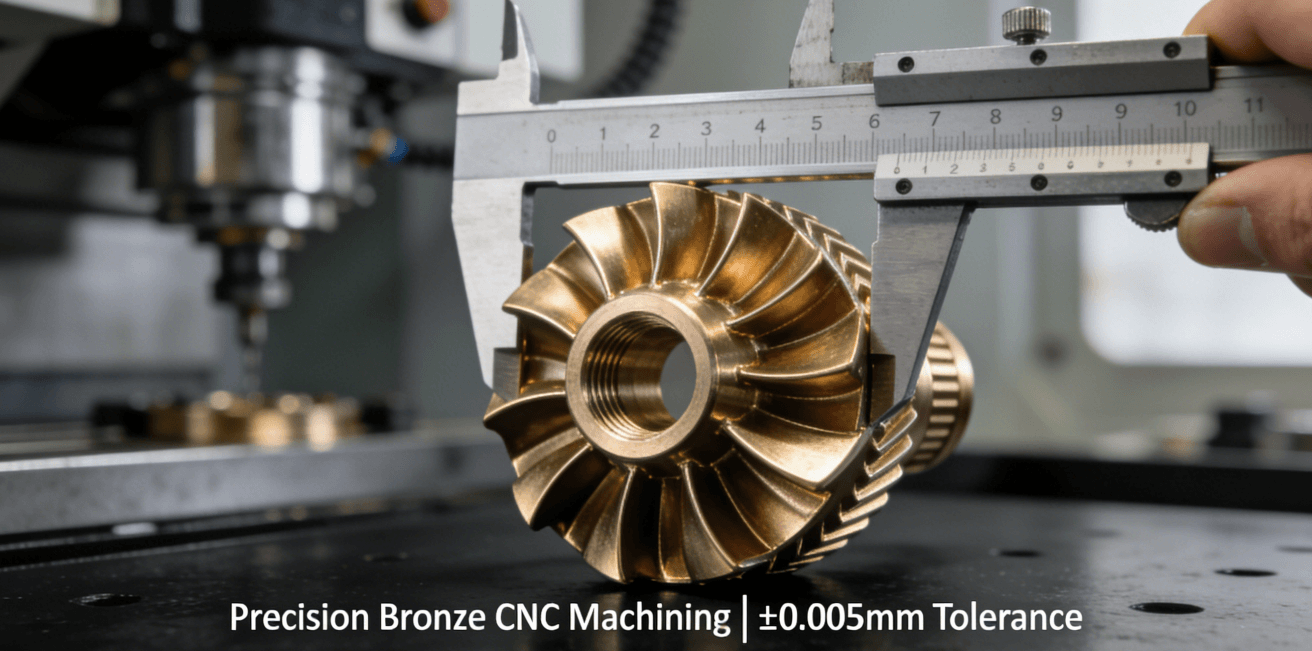
A surface finish of Ra ≤ 1.6μm is achievable with dedicated practice. This is done by following a multi-step procedure, initially with parameters that prioritize material removal, followed by semi-finishing and finishing operations with increasing spindle speeds, decreasing feed rates, and minimal depth of cut. The final cut is done with a dedicated finishing cutter that is sharp. In addition, the correct implementation of CNC machining bronze , as described by experts in the field, points to the significance of optimizing the tool paths as well as the machine’s rigidity, avoiding vibrations that may adversely affect the surface finish.
Why is a Strict Quality Assurance System Crucial for Bronze CNC Parts?
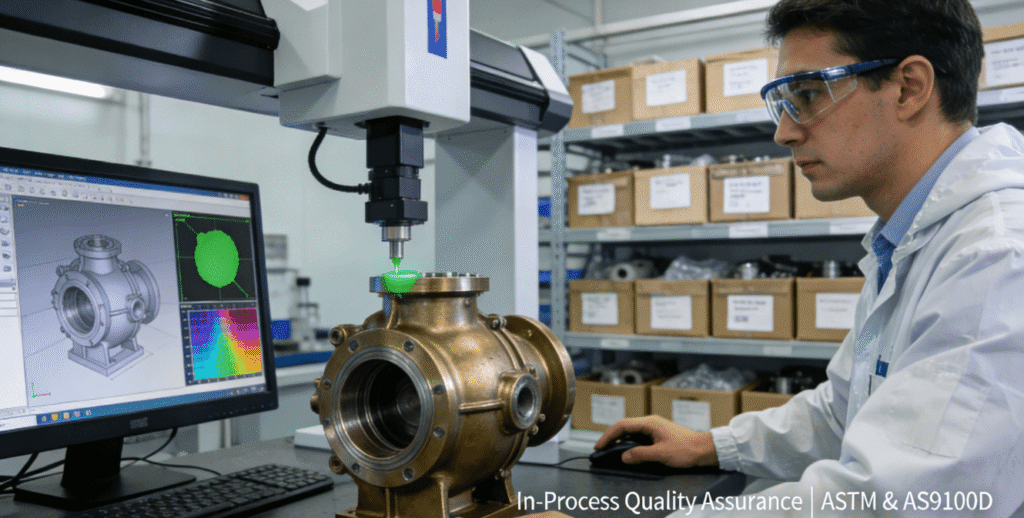
For critical applications involving bronze parts, a strong Manufacturing quality assurance system is an absolute must. This is essentially the foundation of all reliability, safety, and consistency from raw materials through to delivering trusted CNC machining parts.
A comprehensive quality assurance system covers all phases of manufacturing. This includes raw material certification to ASTM or other applicable material specs. During production, Statistical Process Control (SPC) is used to monitor critical machining parameters in real-time. This helps to make the corrections before any non-conforming products are produced.
Lastly, advanced metrology instruments like Coordinate Measuring Machines (CMMs) are employed for validation so that all critical dimensions have specified tolerances. Choosing a supplier who is certified to international quality management standards such as ISO 9001, IATF 16949 (automotive sector), or AS9100D (aerospace sector) gives us a great boost. This is because these certifications serve as proof of the supplier’s adherence to a quality system that is process-oriented in nature. This system not only helps in minimizing defects but also enables traceability which is very important in ensuring the project timeline and total cost of ownership are not compromised.
How Can Chinese CNC Machining Services Meet Global Demand for High-End Bronze Components?
The international market for precision bronze components is increasingly looking towards CNC machining china as a viable solution. The CNC machining china industry has developed into an attractive proposition with the combination of advanced technological capabilities, CNC bronze machining expertise, and a competitive cost structure.
Integrated Technical and Supply Chain Advantages
The advanced manufacturing base of China offers integrated solutions. From the availability of a wide variety of certified bronze alloys, the ability to utilize advanced multi-axis CNC machine tools, and the implementation of rigorous quality control procedures, the complexity of the project can be efficiently managed by the suppliers, with the additional advantage of the depth of the supplier network.
- Digital Collaboration Platforms
China’s best manufacturers use digital collaboration platforms for effortless communication, real-time project monitoring, and collaborative DFM (Design for Manufacturability) analysis. This facilitates communication, ensuring that the technical specifications are perfectly understood and met.
- Comprehensive Service Integration
It is imperative to provide a true CNC machining tolerance service. It includes not only machining but also additional services that provide added value, such as finishing, quality inspection, and assembly. More importantly, it includes effortless logistics management, including international shipping, customs, and delivery, providing a single point of accountability for global clients.
Commitment to International Standards
To cater to the global needs of the aerospace, automotive, and marine industries, the best machine shops in China heavily invest in attaining and complying with international quality and management system standards (e.g., AS9100D, IATF 16949). It represents the universal language of quality, ensuring that the parts produced in China are of the highest quality, meeting the stringent quality standards set across the globe. Companies like JS Precision exemplify this commitment by adhering to these rigorous international protocols.
From Design to Delivery: How to Optimize the Total Lifecycle Cost of Bronze CNC Parts?
The optimization of the cost of custom bronze parts is not just limited to cost but rather considers the Total Cost of Ownership (TCO). The strategic decisions that are made during the planning phase of CNC machining parts are the most significant.
The application of Value Engineering (VE) is a great way to save costs. Value engineering should be applied as early as possible in the design phase. The application of VE will include simplification of part geometry, tolerance reduction, standardization of features such as hole sizes and thread types, etc. Additionally, consultations with manufacturing engineers during DFM can help in identifying alternative machinable bronze alloys that are easier to process at a lower cost.
Process optimization, like the ability to nest multiple parts onto a single stock material or optimize machine paths for the least air-cutting time, minimizes waste as well as machine time. Lastly, working with a company that offers integrated supply chain services may help minimize the overall steps needed in the process. A case study may illustrate the reduction of overall project cost by over 20% on a complex bronze valve body design, while maintaining all performance specifications.
Conclusion
The process of precision bronze CNC machining is an engineering discipline that requires success based on an intimate understanding of materials science, precise management of all process variables, and an unyielding dedication to quality assurance during the entire manufacturing process. Adherence to international standards, utilization of cutting-edge CNC machining and inspection technologies, and partnering with an experienced manufacturing organization are the definitive success criteria for obtaining high-performance, dependable bronze CNC machined parts.
For engineering and procurement professionals requiring dependable CNC machining bronze solutions for critical applications, partnering with an experienced and certified manufacturing organization for a technical design review and quotation is highly recommended.
Author Biography
The author of this article is a mechanical engineer with over 15 years of specialized experience in JS Precision, specifically advanced material selection and CNC machining process optimization for aerospace and high-performance industrial equipment applications.
FAQ
Q: What is the fundamental difference between machining bronze and brass?
A: Bronze is harder and has greater wear resistance than brass but, in return, may result in tool wear. Hence, it is important to have optimal cutting parameters and cooling for machining bronze.
Q: What is the biggest problem in machining aluminum bronze, such as C95400?
A: The main challenge in machining aluminum bronze, particularly C95400, is due to the metals hardness and the materials tendency to work-harden.
Q: What are the steps for ensuring consistency in the production of bronze?
A: To make sure the production of bronze remains consistent, one can use Statistical Process Control (SPC) to monitor and control key dimensions during production. Also, employing automated inspection machines, such as Coordinate Measuring Machines (CMMs), and having a quality management system certified for ISO 9001 are good practices.
Q: For those components that have strict corrosion resistance requirements in marine environments, what type of bronze is recommended?
A: Both Aluminum bronze (such as C95400) and naval brass (C46400) are excellent choices for long exposure to seawater as they offer very good corrosion resistance. Hence, these two alloys are often used for marine applications like ship fittings, pumps, and valves.
Q: When purchasing CNC machined bronze products from Chinese suppliers, what is the best way to ensure communication and quality?
A: It is highly recommended that one selects a supplier that is able to provide “integrated CNC machining tolerance service,” has English technical documents, as well as relevant international quality management system certifications such as “AS9100D.” The use of virtual tools to track projects is also essential, as is communication with dedicated engineering support.