

 Backlinks Hub
For many postgraduate students at UK universities, the transition from taught modules to the independent research phase is a daunting leap. Whether you are studying at Russell Group institutions or specialist modern universities, the “Methodology Chapter” often stands as the most significant hurdle. It is the engine room of your thesis; if the methodology is flawed, the entire research project risks losing its academic rigour.
The primary dilemma most researchers face is the choice between qualitative and quantitative research. In the UK academic system, where critical analysis is weighted far more heavily than simple description, choosing the right path is not just about preference—it is about alignment with your research aims, your philosophy, and your data.
Understanding the Core Philosophy
Before you dive into data collection, you must understand the “why” behind your choice. UK marking rubrics for Master’s and PhD theses look for a deep understanding of epistemology—how we know what we know.
Quantitative Research: The Quest for Objectivity
Quantitative research is rooted in positivism. It assumes that there is an objective reality that can be measured through numbers, statistics, and logic. If your research question starts with “To what extent,” “How much,” or “What is the relationship between,” you are likely looking at a quantitative study.
Common characteristics in a UK context include:
- Large Sample Sizes: Ensuring the results are statistically significant.
- Standardised Tools: Using surveys, polls, or existing datasets (like the ONS or NHS Digital).
- Deductive Reasoning: Testing an existing theory against new data.
For a deeper dive into the mechanics of numbers-based studies, exploring a detailed guide on quantitative research can help you understand how to structure your hypotheses and p-values effectively.
Qualitative Research: The Search for Meaning
Qualitative research, conversely, is often interpretivist. It suggests that reality is socially constructed. If you are exploring “How do students experience…” or “Why do certain corporate cultures fail…”, you are seeking depth over breadth.
Key elements include:
- Small, Purposive Samples: Focussing on specific individuals who have lived the experience.
- Unstructured or Semi-structured Data: Using interviews, focus groups, or ethnographic observations.
- Inductive Reasoning: Building a theory from the ground up based on the data collected.
Comparing the Two: A Quick Reference for UK Postgrads
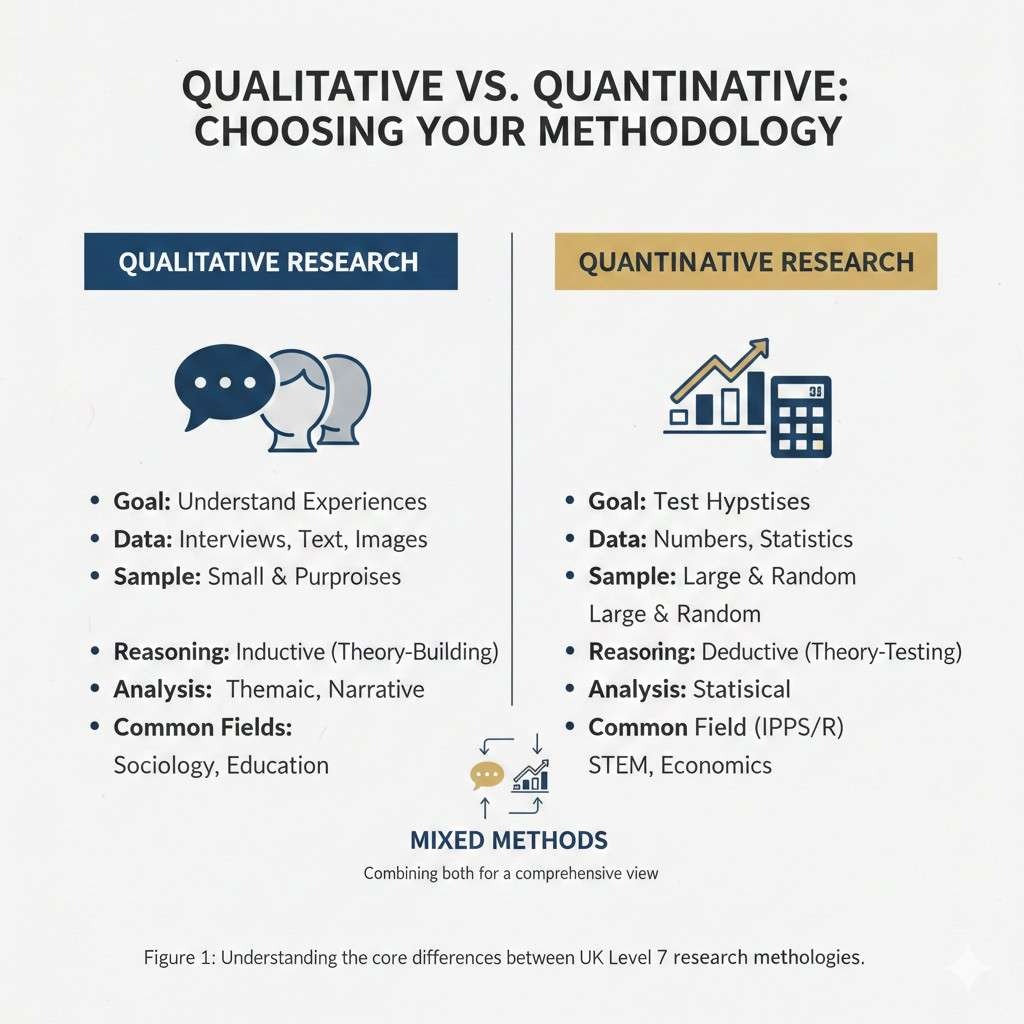
| Feature | Quantitative | Qualitative |
| Goal | To test hypotheses and look for patterns. | To understand concepts, thoughts, or experiences. |
| Data Format | Numbers and statistics. | Words, images, and videos. |
| UK Academic Context | Common in STEM, Economics, and Psychology. | Common in Sociology, Education, and Humanities. |
| Key Limitation | Can lack “human” context or nuance. | Can be prone to researcher bias if not mitigated. |
How to Choose the Right Path for Your Thesis
Choosing your methodology is not a flip of a coin. At the postgraduate level, your choice must be “defensible” during your viva or by your markers. Here are three steps to making the right decision:
1. Align with Your Research Question
Your methodology should be the natural consequence of your research question. If your goal is to find out if “Remote working improves productivity in London’s tech sector,” a quantitative survey of 500 employees provides a broad, statistically valid answer.
However, if you want to know how remote working changes the mental health of those employees, you need the nuance of qualitative interviews. When the requirements become complex, many students find that seeking specialised research paper help allows them to refine these questions into a manageable scope before they even start writing.
2. Consider Your Resources (Time and Access)
A common pitfall for UK students is choosing a methodology they cannot complete within the 12-month Master’s cycle.
- Quantitative: Requires time for data cleaning and learning software like SPSS or R.
- Qualitative: Requires time for transcription (which can take 4 hours for every 1 hour of interview) and thematic analysis.
3. The “Mixed Methods” Middle Ground
In recent years, UK universities have increasingly championed “Mixed Methods.” This involves using a survey to find a trend (quantitative) and then following up with interviews to explain that trend (qualitative). While this offers a comprehensive view, be warned: it essentially doubles your workload.
Navigating the Ethics Process in the UK
Regardless of your choice, your methodology must pass a rigorous Ethics Committee review. UK universities are particularly strict regarding:
- Informed Consent: Especially when dealing with vulnerable groups.
- GDPR Compliance: How you store and anonymise your data.
- Researcher Safety: Especially for qualitative field researchers.
Failure to address these in your methodology chapter can result in an automatic fail, regardless of how good your data is.
Why Methodology is the Key to a “Distinction”
In the UK, the difference between a “Pass” (50-59%), a “Merit” (60-69%), and a “Distinction” (70%+) often lies in the justification of the methodology.
A “Pass” student simply describes what they did. A “Distinction” student explains why they chose that specific method over others, acknowledges the limitations (e.g., “The sample size was limited by the scope of the Master’s programme”), and explains how they ensured the validity and reliability of their findings.
Expert Support for the “Heavy Lifting”
Let’s be honest: the academic pressure on UK graduate students is immense. Between work commitments and the high cost of living, finding the time to master complex statistical software or transcribe 20 hours of interviews is a struggle.
If you find yourself stuck at the methodology stage, it is often helpful to look at model examples or seek professional guidance. Utilising comprehensive academic support services can provide you with the clarity needed to structure your chapters correctly, ensuring you meet the specific formatting and critical-thinking requirements of your university.
Conclusion: Let the Data Lead the Way
Whether you choose the precision of quantitative numbers or the depth of qualitative narratives, the key is consistency. Your philosophy, your data collection, and your analysis must all speak the same language.
By choosing a methodology that is both feasible and theoretically sound, you aren’t just writing a thesis—you are contributing to the wider body of UK academic research. Take the time to plan, consult with your supervisor, and don’t be afraid to seek help when the technical requirements of your research feel overwhelming.
About the Author
Sienna Kelly is an education writer and researcher passionate about making higher education more accessible for the modern student. From mastering complex referencing to demystifying research methodologies, Sienna’s work focuses on reducing the stress of graduate-level study. She currently leads the research support team at MyAssignmentHelp, providing students with the tools and expert guidance they need to excel in their academic journeys.