
 Backlinks Hub
The modern retail landscape is undergoing a massive spatial shift, moving away from entirely physical showrooms toward highly interactive digital environments. Consumers purchasing high-ticket items, particularly home decor and large furnishings, now expect to preview these items in their own living spaces using Augmented Reality (AR) before committing to a purchase. Creating these interactive digital twins historically required armies of 3D artists manually modeling every curve and texturing every surface, creating a severe bottleneck for large retail catalogs. To solve this scalability issue, enterprise brands are adopting generative artificial intelligence. At the forefront of this industrial transition is Neural4D, a highly advanced 3D reconstruction system jointly developed by Nanjing University, DreamTech, Oxford University, and Fudan University. This academic partnership has delivered a platform capable of handling the rigorous optical demands of industrial product rendering.
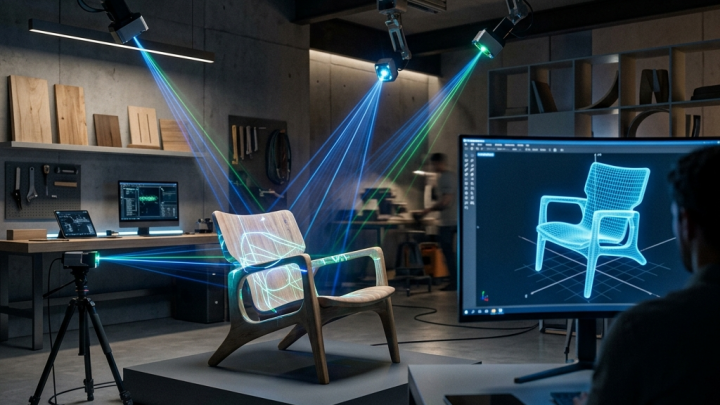
By leveraging advanced neural architectures, furniture manufacturers can now digitize physical furniture into 3D models with unprecedented speed and geometric accuracy. Instead of measuring angles and manually projecting textures, a user can simply capture a short video or a series of photographs of a physical chair or sofa. The AI framework processes this 2D visual data and automatically extrapolates a fully textured, dimensional asset ready for deployment in spatial commerce applications, drastically reducing production overhead.
Overcoming the Complexities of Organic Materials
Digitizing furniture is technically demanding due to the wide variety of complex materials utilized in manufacturing. A single armchair might feature highly polished metallic legs, a matte wooden frame, and a deeply textured velvet cushion. Traditional photogrammetry struggles immensely with these mixed optical properties, often producing corrupted meshes when encountering reflective metals or failing to capture the subtle depth of fabrics.
The generative models utilized in modern AI pipelines solve this by applying intrinsic material decomposition. The neural network separates the raw geometric shape of the object from its surface appearance and the environmental lighting.
When capturing wood grains or leather, the system automatically generates specific Physically Based Rendering (PBR) maps. It extracts a dedicated roughness map to ensure the leather catches virtual light exactly as it would in reality, and a high-frequency normal map to replicate the microscopic bumps of fabric threads. This level of automated detailing ensures that the final 3D asset looks identical to the showroom piece, preventing the flat, artificial look that plagues low-quality digital models.
Geometry Optimization for Augmented Reality
While generating a photorealistic asset is a massive achievement, the model is useless if it is too heavy to load on a consumer’s mobile device. AR applications on iOS and Android operate under strict computational constraints, requiring low polygon counts to maintain a smooth 60 frames per second framerate during spatial tracking.
Automated 3D reconstruction systems address this through intelligent geometry decimation. Rather than indiscriminately reducing the polygon count, the AI analyzes the physical structure of the furniture. It retains high-density polygons on curved surfaces, such as the rounded armrest of a sofa, while aggressively stripping away unnecessary vertices on flat surfaces like the seat or the backrest.
This smart topology management results in a quad-dominant mesh that balances striking visual fidelity with an extremely lightweight file size, ensuring instantaneous loading times for mobile shoppers.
Technical Specifications: The Digitization Pipeline
To illustrate the efficiency of this automated workflow in a commercial setting, it is necessary to review the operational specifications of the generation engine.
| Operational Metric | Neural4D Processing Benchmark |
| Input Requirement | 20 to 50 standard 2D images or 30-second video |
| Processing Time per Asset | 5 to 12 minutes |
| Extracted PBR Layers | Albedo, Normal, Roughness, Metallic |
| Output Mesh Optimization | Automated edge-flow and targeted decimation |
| Supported Export Formats | GLB, USDZ, OBJ (Ready for WebXR and ARKit) |
This operational data highlights why the industry is rapidly pivoting away from manual 3D modeling studios. The ability to push an entire seasonal furniture catalog through an automated pipeline in a matter of days changes the fundamental economics of digital retail.
Collaborative Interior Design Workflows
Creating the individual 3D furniture piece is only the first step in the spatial design process. Interior designers and marketing teams must place these digital products into contextual environments to create compelling lifestyle imagery. A standalone sofa is less persuasive than a sofa placed within a beautifully lit, sun-drenched virtual living room.
This is where collaborative digital ecosystems become highly valuable. A design team can digitize their proprietary furniture utilizing AI, and then access community resources to build out the surrounding room. By utilizing collaborative platforms, designers can share your 3D creations or download generic background elements like potted plants, window frames, and flooring textures.
Combining highly accurate, AI-generated hero assets with accessible community geometry allows marketing teams to construct vast, photorealistic interior scenes rapidly. This hybrid workflow maximizes computational focus on the branded product while significantly reducing the time spent modeling secondary background items.
A New Era of Spatial Commerce
The integration of automated 3D reconstruction into the furniture and interior design sectors is establishing a new standard for online retail. By enabling brands to rapidly convert their physical showrooms into lightweight, photorealistic digital assets, generative AI is directly addressing consumer demands for interactive spatial try-ons. The ability to automatically resolve complex material properties and optimize geometry for mobile augmented reality ensures that these digital representations remain perfectly faithful to the original products. As these neural architectures continue to advance, the friction between physical manufacturing and digital distribution will disappear entirely, offering consumers an unprecedented level of confidence and interactivity in their digital shopping experiences.